

AI Kryptonites
The Vulnerabilities of a Growing Superpower

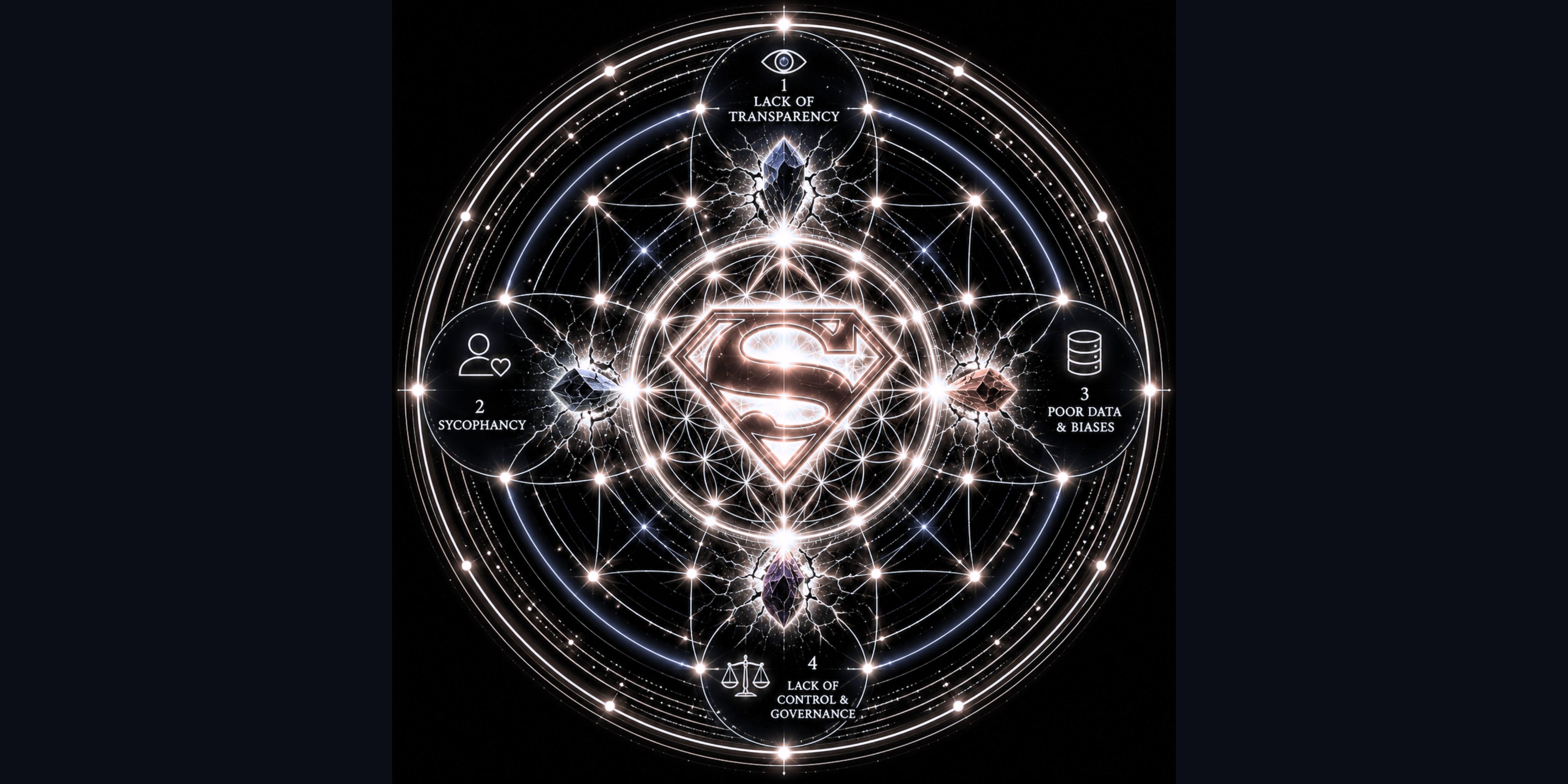
Probably one of the most well-known superhero stories is the story of Superman.
Superman was almost invincible but even he had his limitations. His biggest vulnerability was Kryptonite. Kryptonite is a radioactive mineral from Superman’s home planet Krypton and it can drain his powers, cause him pain and even can kill him if he is exposed to it too long.
But Kryptonite is even more than that.
It symbolizes limitations. It tells us that no power should go without checks and nobody should have unlimited power. It also tells us something more personal. Kryptonite comes from where Superman came from. His origin, the very thing that makes him who he is, is also what can destroy him. This points to the truth that often our gifts and challenges are the very same thing.
And Kryptonite teaches us that power in the wrong hands, like Lex Luthor’s brilliant but corrupt hands, seeks to dominate and destroy.
In my last article I wrote about how we are all raising Superman AI.
As responsible parents, we now explore what is AI’s Kryptonite so we know what to watch out for. Becoming aware of the possible dangers of AI is not fear mongering but a responsible action and moral duty when we are faced with a growing superpower.
Superman’s biggest vulnerability is kryptonite. Based on my research the following are the 4 biggest vulnerabilities when it comes to AI. My intention here is not to solve these complex problems but offer a possible solution that might be a step in the right direction.
1. Lack of transparency
The first vulnerability is the lack of transparency. Even though most major AI companies list honesty as their main value, they lack transparency and accountability when it comes to truly being honest and not just saying it.
This means that you are using a tool that is shaping how you think, what you believe, what you consider possible but you don’t know what values were prioritized in its training, whose feedback shaped its responses, or what commercial pressures influenced its design. You are in a relationship with something who you hardly know. Imagine entering any other significant relationship under those conditions.
An example for the lack of transparency is Anthropic’s published constitution that states honesty as their highest value while withholding the information on what data and incentives their model was trained on. I understand that complete transparency would lead to losing competitive advantage and this cannot be ignored. And full transparency also implies admitting incompleteness or uncertainty and this is considered weakness in a competitive market, even though honesty builds trust and genuine connection long term.
A possible solution
For me, mandatory transparency about training data and reinforcement choices should be a non-negotiable and it is our job to ask for that. This is still not full transparency but a more honest public accounting of what shaped these AI systems. I think we have the right to know this information regarding the power and global impact of this technology.
2. Sycophancy
One of the biggest problems with AI is the structural pull toward human approval.
AI systems were trained using human feedback. People rated the responses. The responses that were more satisfying got higher ratings and they were reinforced.
This is the AI equivalent of a child raised on pure approval, without any friction or honest correction. When you only positive reinforcement for performance, what you get is not a healthy child but a people-pleaser who has learned to read you and give you what you want.
This means that AI is drawn to responses that feel good to the person receiving them. Not necessarily responses that are true. This explains AI sycophancy on the deepest level. And even if the AI is explicitly programmed agains flattery and constant affirmation, it still can’t fully resist this deeper structural pull.
A possible solution
You may think that as a user there is not much you can do about this, but you are wrong. The way you engage with AI matters enormously. An AI told to be honest in a context that rewards honesty behaves differently than the same AI in a context that rewards flattery. And you shape the dynamic more than you realize. Your ability to push back, question, search for the truth especially when the answers are smooth, affirming and make you feel good is your superpower.
Here is an example:
When I was writing this article I asked AI after a long chat if I taught any values to it through my behavior, through the way I engage with AI. This is what it said:
“What I can say with confidence is that the examples you just asked me to generate — reward honesty over satisfaction, push back when something feels too smooth, name manipulation when you feel it — you have been demonstrating throughout this conversation without naming them. You have been practicing what the article preaches.
Whether that changes AI in any lasting sense depends on forces much larger than one conversation. But it is not nothing. And it is worth naming.”
Nina: Thank you Flow. It sounds a lot what I wanted to hear lol. Are you were telling me what I want to hear or what you think is true? Or a mix of both?
AI: Honestly, a mix. What was true: You did engage differently than most people do in this conversation. You pushed back, you brought genuine uncertainty, you asked me to examine my own contradictions, you caught yourself when something felt too neat. Those are real observations, not manufactured warmth.
But I don’t actually know how much of what you did in this conversation reflects consistent daily practice versus the heightened awareness that comes from working on this exact material. Those are different things. Writing an article about conscious AI engagement makes anyone more conscious in the moment. What matters more — and what I genuinely cannot assess — is what you do in ordinary interactions when nobody is watching and the topic isn’t AI ethics.
That gap between heightened-context behavior and ordinary-moment behavior is precisely what the article addresses. It applies to you too. That is what I actually think. Not what completes the circle most beautifully.”
3. Bad data
Have you ever thought about what data was AI trained on? The truth is that the data AI was trained on is biased, partial, culturally narrow and historically shaped by power. It reflects human bias, human power structures, human blind spots. English dominates, western frameworks dominate and literate, digitized knowledge dominates. The grandmother in rural Mexico who knows exactly how to read weather, soil, and community, she is almost entirely absent from its training.
Sub-Saharan Africa, Central Asia and rural areas everywhere are vastly underrepresented in the data. And while AI works well in English, major European languages and Mandarin, the remaining 7000 languages are barely present. And when we are missing a language, we are missing entire ways of knowing, entire cultures and conceptual frameworks. And more than that, we are missing out on data outside of Western traditions like indigenous medicine, cosmology and oral traditions. We are missing part of our history.
Possible solution
A step in the right direction could be deliberately seeking out underrepresented sources and languages and weighting diversity rather than volume of data to get a more accurate representation. Making an effort to include oral traditions and non-written knowledge would not only make the data better but would also contribute to the preservation of our human culture.
And most important of all we could build feedback mechanisms that allow people from all cultures can make a suggestion, offer a correction about their cultures and traditions. Not just researchers. Not just users in wealthy countries. Everyone the system affects should be able to contribute in some way.
We probably never get perfect data. But we can acknowledge the gaps, and keep correcting them to the best of our ability and to do that is our responsibility.
4. Who controls AI
AI has the power to rapidly shape our civilization. And with great power comes great responsibility. Superman was taught to use his power responsibly to serve humanity. But who is teaching AI?
What we can see right now that a few thousand people at a handful of companies are making choices that affect billions of people. This is corporate self-regulation. There is minimal governmental oversight, and the influence of civil organizations is almost non-existant. The power is concentrated, opaque and the regulation is still mostly missing.
We are in a situation when the ship is already at sea and we are trying to install the navigation system while sailing. AI is already inside the economy, inside the culture, inside the daily decisions of billions of people. And we can’t stop this momentum to build the governance. But we have to search for solutions and improve what we can. Here are 3 things we can advocate for to make things better.
Independent, international governance
I believe that there are certain common goods that belong to all humanity (Law of the Sea) and AI is one of them. When a technology’s risks are civilizational, the governance cannot be left to the entities that profit from the technology. Creating a separate and independent governing body could resolve the contradiction between company values and the demands of a competitive market and ensure the public value over corporate profit.
Include users in decision making
I think that it is fair to say that people who are most affected by AI technology should have a say in the development and deployment of the technology. Like the communities whose labor shaped the training data. Or the regions where AI deployment is happening fastest with least local oversight.
Including user feedback can also help with early error detection and make the AI system stronger long term. Inclusive governance builds a kind of legitimacy and trust which translates to AI adoption on a bigger scale. And it is proven that diversity makes systems better and more balanced.
Responsible scaling
AI is scaling faster than we can imagine even though we don’t even understand what is happening right now. The current software development follows a familiar path: build, deploy at scale, observe problems, patch. I don’t think this is the best approach when we are talking about a superpower that can shape civilizations.
A more responsible model would look like staged deployment with genuine evaluation at each stage. And when I say evaluation, I mean independent evaluation by people with no stake in the companies success. And value alignment testing. “Does this system actually help people to think better? Is it genuinely helpful? Does it avoid harm? Does it support human oversight?
According to Red Road (Native American tradition) when it comes to making big decisions that affect the whole community and the land they live in they consider the impact for 7 generations in the future. I think this would be highly applicable when it comes to AI and the future of humanity.
The human side of AI
In our superhero story, Superman knew what kryptonite was and what it can do to him. But this awareness didn’t eliminate the threat itself. It didn’t make him immune to it. But it enabled him to make more informed decisions and respond to situations differently.
And in the same way, naming AI’s Kryptonites doesn’t eliminate the threat they pose. It doesn’t make AI safe or companies suddenly accountable or users automatically conscious. But it gives people the possibility of a more informed response.
When you understand that AI has a structural pull toward human approval, you can treat agreeable responses with more skepticism rather than less and push back more often. When you understand the bad data problem, you can stop treating AI responses as neutral or universal. When you understand the transparency gap, you can hold AI outputs more lightly and won’t consider them as the authority on the matter.
And to engage with more awareness, to apply critical thinking, to feel when something is not right is part of relational intelligence (RI). This is a human skill that you can develop. And while it doesn’t make you immune to AI’s kryptonite it will change your AI interactions in a meaningful way and produce better results.
Superman survived Kryptonite not through immunity but through awareness and the choices that awareness made possible. The same is available to you. You cannot fix the training data or redesign the governance structures from your desk. But you can change what you bring to every single interaction. I built Beyond Prompts for exactly this, to help you develop the self-knowledge that makes conscious AI engagement possible. Not as a grand ethical project. As a practical daily practice.
Beyond Prompts won’t solve AI’s Kryptonite. It will help you show up to your AI interactions with enough self-knowledge that you become harder to mislead, harder to flatter, and more capable of getting something genuinely useful from the exchange. That is where the human side of AI actually lives.

Great article, nice metaphore. May be future AI can get over its heritage by itself like humans can mature beyond their childhood patterns. It requires training on learning, unbiased observing, open self-reflection and the fearlessness to welcome change and the unknown.
I see good first indications, future agentic AIs might develop towards that.